
Hypo-Reality (or the Ubiquity of Disinformation)
As long as we evolve, both as human beings and technological beings, the breach between science and fiction is becoming shorter. A few decades ago, when characters like Jules Verne were imagining amazing machines that could make us arrive to the moon and beyond, they were farther from the real construction of these devices. Nowadays, as technology is evolving in an exponential way, our imagination is closer to a future reality.
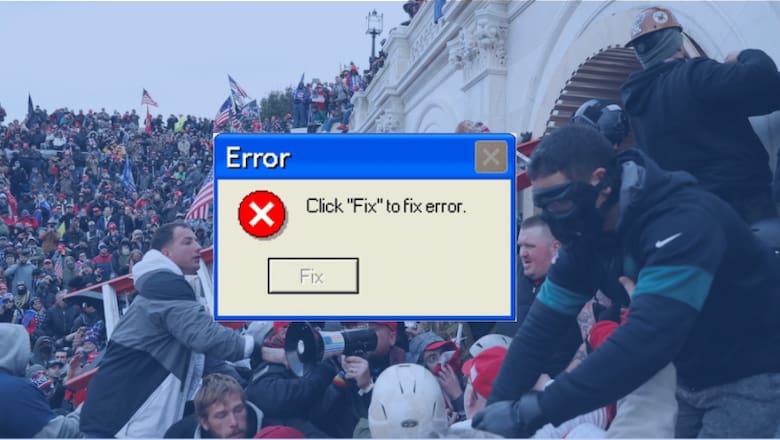
Capitolium assault image w/ Error window
That’s also what, sadly, is happening now with the sanitary situation. A worldwide disease is tearing apart countries, societies, families… as if we were in one of those apocalyptic films.
We even had a Capitolium assault… Damn, I just miss the alien stuff!
But the truth is that this situation has accelerated the reach of the fiction future, especially regarding the media and digital consumption. In a few months, the whole population with access to a minimum of digital devices has increased their use of it, no matter what age, gender or cultural situation.
In this context, we find ourselves surrounded by a hyperreality situation, similar to the project by Keiichi Matsuda attached at the video below. In our case, we might not be surrounded physically, because AR devices are still not that common in our daily lives. But media and information had been increasing monumentally. It brings to my memory the pop-ups appearing in the early 2000 websites. For some years, they had appeared in our screens showing us how we can had free sex or earn billions easily. Nowadays, it’s not that common and, in general, we have learned to discern the scam from the bid.
Hyper reality, by Keiichi Matsuda
But again, what happens with information? Newspapers have always been linked to the economy and capitalism. Following one or another position, in terms of money the real profits came from big branding and advertisements.
It’s logical to suppose that information works in the same way as the rest of design objects. It’s a product created in series, in a daily format, but with its own shape and needs in terms of arriving to the general public. Unfortunately, this means: tell whatever “they” want. Who are they? Politics, youtubers, petrol corporations, religions, non-profit organizations, fashion influencers? They are everyone, even us. Because with the explosion of social media channels, we lost the ability of discerning between the fake and the real news, the opinions and the reality, as everyone can create his own user and start spreading the word.
Most of the science fiction examples, focused both on dystopian or utopian universes, imagine hyper-reality as a continuous commercial following our daily lives. For instance, in the novel by Philip K. Dick “Ubik”, each chapter starts with an advertising of a new product, each of them called “ubik” even if they are totally different in between. It’s a reference to this ubiquity of capitalism and the power of money. But almost none of these hyper-real fiction futures explores the ubiquity of information and the multiplicity of fake news. The spread of disinformation.